Guide
Padel court dimensions: size, net, glass and service lines
A padel court is small, enclosed and precisely regulated. The measurements are the same at a club in Norrköping as in a hall in Malmö, which is exactly why the game feels identical wherever you play. Here are all the numbers you need, from the outer dimensions to the service line, and what they mean once you are standing on court.
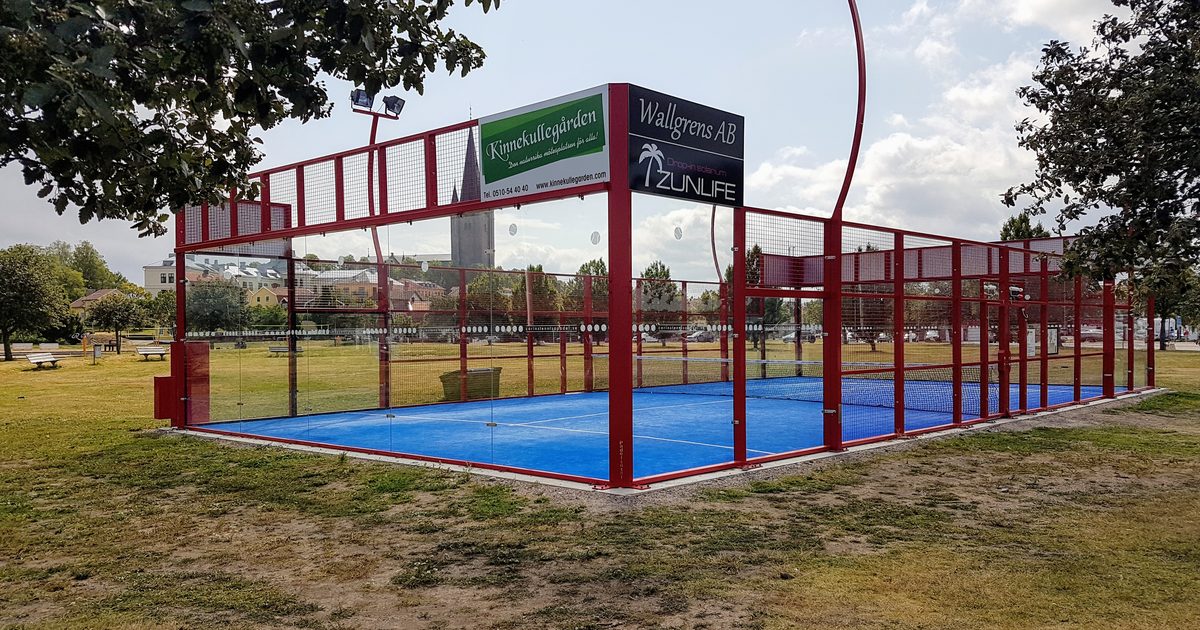
Outer dimensions: 20 x 10 metres
A doubles court measures 20 metres long and 10 metres wide, measured inside the enclosure. The net splits it in half, so each pair defends an area of 10 x 10 metres. A tolerance of half a percent is allowed, which in practice means a few centimetres. All lines are 5 centimetres wide and white or in clear contrast to the surface.
The fact that each side is square matters more than it sounds. You rarely cover more than a couple of steps sideways, so positioning is decided by depth: who dares to stand at the net and who drops back towards the glass.
The net: 88 centimetres in the middle
The net is 10 metres long and 88 centimetres high in the centre. At the posts it is 92 centimetres, so 4 centimetres higher. That small dip in the middle is the reason so many volleys go straight down the centre of the court, it is simply the lowest way over.
The mesh must be tight enough that a ball cannot pass through, and the top band is white so net contact is visible. If the ball clips the band and lands in, the point stands, just like in tennis.
Service lines and service boxes
Each half has a service line 6.95 metres from the back glass, parallel to the net. A centre line runs from the service line to the net and splits the area into two service boxes. The serve must bounce in the diagonally opposite box, and it may hit the glass afterwards without any penalty.
The serve is played underhand after one bounce on the floor, with contact at or below waist height and both feet behind the service line. That 6.95 metre distance is exactly why a hard serve is rarely dangerous: the ball has lost pace and the receiver has both the glass and the time on their side.
Glass, mesh and wall heights
The ends are built from glass 3 metres high with 1 metre of metal mesh above, 4 metres in total. Along the sides the glass steps down: 3 metres closest to the back wall, then 2 metres, and after that the enclosure continues in mesh. Players enter through the openings in the middle of each side.
Every surface is playable once the ball has bounced on the floor on your side. The difference between glass and mesh is large in practice: glass gives an even, predictable rebound, while metal mesh kills the ball and sends it in unexpected directions. That is why players deliberately aim for the corners where the two materials meet.
Ceiling height, light and surface
Clear height above the whole court should be at least 6 metres, and 8 metres is recommended for indoor competition. In a hall with a lower roof you notice it immediately: high defensive lobs are unusable and the match becomes flatter and faster.
The surface is usually artificial turf with sand, sometimes rubber or a mat, and it must be a single colour in green, blue or terracotta. Lighting normally sits between 300 and 500 lux, with competition courts aiming at the upper end. The sand affects the bounce more than most people expect, a freshly sanded court is noticeably slower.
Singles court: same length, narrower
A singles court is 20 metres long and 6 metres wide. The net is then 6 metres, while the net height and the 6.95 metre service line stay the same. The narrower area removes the angles and turns the match into an endurance exercise down the middle. Singles courts are rare in Sweden, but if you book one, expect positioning to work nothing like doubles.
What the numbers mean for your game
Three conclusions follow straight from the measurements. The court is short, so placement beats power. The net is lowest in the middle, so the safest attack goes through the centre. The walls are in play, so a ball that passes you is not automatically lost.
The rest is habit. Four players on 200 square metres need to agree on who takes the middle, and you learn that fastest by playing people at your own level. If you need to fill a court, there are vacant spots in already booked matches in the match feed.
Frequently asked questions
How big is a padel court?
20 metres long and 10 metres wide for doubles, measured inside the enclosure. Each pair defends 10 x 10 metres.
How high is the net?
88 centimetres in the middle and 92 centimetres at the posts.
Where is the service line?
6.95 metres from the back glass, parallel to the net, with a centre line splitting the area into two service boxes.
What ceiling height is needed indoors?
At least 6 metres of clear height, and 8 metres is recommended for competition.