Guide
Playing padel with two players: single courts, rules and five ways to play
Padel is built for four players, but real life rarely cooperates. A friend cancels, a colleague just wants to try it, or you have a free lunch hour and nobody else can make it. That raises the question: can you play padel with only two people? You can, and there are more options than most players realise. This guide covers the single court, one on one rules, how to use a standard doubles court and when it makes more sense to add two more players.
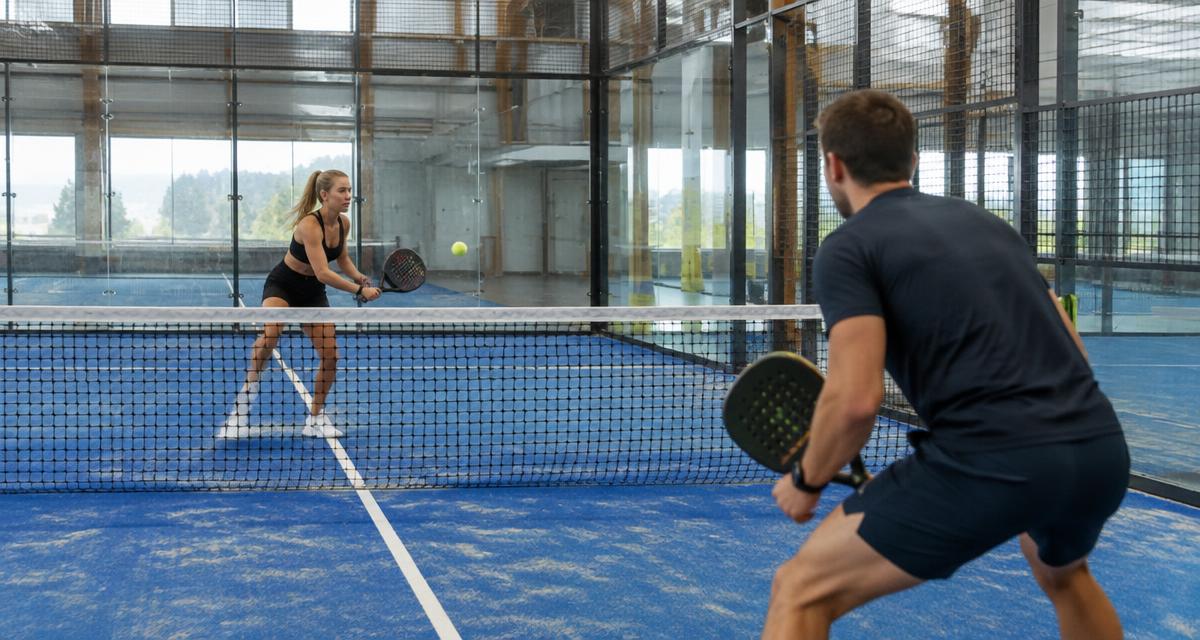
Can you play padel with only two?
Yes. The rules of padel apply to both doubles and singles, and the international federation has its own dimensions for a single court. The catch is that single courts are rare in Sweden. Most venues only have doubles courts, so you adapt the game to the court.
That leaves three main options when you are two: book a single court if the venue has one, play one on one on a normal court with simplified rules, or use the hour for drills instead of a match. The right choice depends on your level and what you want from the session.
Single court dimensions: same length, narrower width
A single court is 20 metres long, just like a doubles court, but only 6 metres wide instead of 10. Each half is therefore 6 x 10 metres. The net, service lines and glass height follow the same principles as a standard court.
The narrower width changes everything. One player can cover 6 metres sideways without the court feeling impossible, while 10 metres alone gets heavy after a few games. That is why the single court is the only setup where a real one on one match stays balanced and fun for a full hour.
Single courts usually appear where a venue had a leftover strip of space, along a wall or in a corner. Ask at reception or look for courts labelled single in the booking system. They are often cheaper and easier to book in the evening, simply because few people know they exist.
You will find every measurement for doubles and singles in the padel court dimensions guide.
The rules one on one
The basic rules are the same as in doubles. A few things still change when there are only two of you on court.
- The serve. Underarm and diagonal as usual. You alternate between the right and left box every point, so both sides get practice.
- The walls. The ball must bounce on the ground before it hits the glass or fence on your opponent's side. On your own side you may play it off the wall after one bounce.
- Scoring. Like tennis: 15, 30, 40 and game. Many players use golden point at deuce to keep the pace up, since singles is more tiring.
- Changing ends. Change sides after every odd game, just as in doubles. It evens out light and any differences between the halves.
- Shorter sets. A set to four or a tiebreak to ten is common. A full best of three match is very demanding on your own.
Two players on a standard doubles court
If your venue only has doubles courts you can still play a match, but you should shrink the court. Otherwise whoever keeps placing the ball out wide against the side fence wins every time, and it becomes more running than padel.
The most popular setup is called cross court or diagonal. You only use one diagonal: you stand in the right box and your opponent in the right box on the other side. Balls landing in the other half count as out. It creates an area similar to a single court and trains exactly the diagonal shots you use in doubles.
Another option is straight play, where you both use the same half lengthwise. It trains shots down the line and makes a good change. Switch between cross court and straight every set to cover the whole court.
Agree on the rules before you start. Say out loud which lines count, whether the side glass on the closed half is in play and how you serve. It takes a minute and saves plenty of arguments.
Five drills that suit two players perfectly
When you are two, practice often beats a match. You hit more balls in one hour than during a whole evening of doubles.
- Volley to volley. Both stand at the net and keep the ball in the air as long as possible. Builds reactions and soft hands.
- Lob and bandeja. One player at the net hits bandejas, the other stays back and lobs. Swap after ten balls.
- Back glass. One player feeds balls at the back glass, the other lets them bounce out and returns them. The most important drill for beginners.
- Serve and return. Ten serves each from each side. Count how many land deep in the box.
- Points from the net. Start every point with one player at the net and one at the back. Whoever wins the net usually wins the point, just like in doubles.
Pros and cons of playing as two
The biggest advantage is the number of balls. In doubles you hit perhaps a quarter of all shots, one on one you hit half. That makes singles a great way to sharpen your technique quickly. It is also tougher on fitness: expect an hour of singles to feel like a long run the day after.
The downside is that you do not practise teamwork. Padel is often decided by how well a pair moves together, covers the middle and picks the right moment to move forward. You only learn that in doubles. Court hire is also more expensive per person when only two of you share it.
A good approach is to use singles and drills as a complement, with doubles as the main course. One session a week in pairs gives noticeably better shots in your doubles matches.
Missing two players? Fill the match
Often you really want a normal doubles match, but there are only two of you. The easiest fix is to post the match with two open spots. Add the time, venue and level, and nearby players can join. With the right level range the match stays even, and the court fee is split four ways instead of two.
It works the other way too. If you are looking for a game yourself, you can join a match where two players are already waiting for the rest. That is how most new padel friendships begin.
See matches with open spots or read more about how to create a padel match.
Two of you and missing two?
Post the match with two open spots and let players at your level fill it. Creating an account is free.
Frequently asked questions
Can you play padel with two people?
Yes. Either on a single court measuring 6 x 20 metres, or on a standard doubles court where you only use one diagonal. Two players also works well for drills.
How big is a single padel court?
A single court is 20 metres long and 6 metres wide. The doubles court is the same length but 10 metres wide.
What are the rules for singles padel?
The same as doubles: underarm diagonal serve, the ball must bounce on the ground before hitting the wall on your opponent's side and scoring works like tennis.
How do I find two more players for a doubles match?
Post the match on Padelpoolen with two open spots, a time, venue and level. Nearby players at the right level can join straight away.